Florida mold licensing is not based on agency preference, internal policy, or discretionary standards. It is grounded in statutory authority enacted by the Florida Legislature and implemented by the Florida Department of Business and Professional Regulation (DBPR).
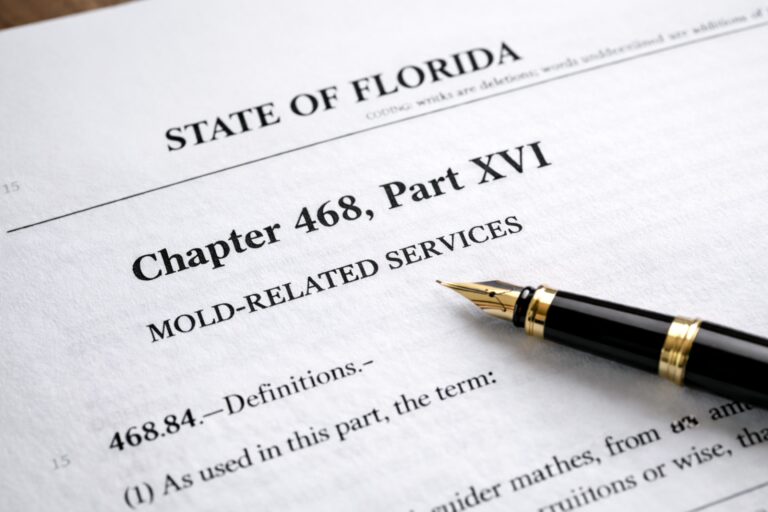
Most confusion surrounding mold licensing does not come from hidden rules or shifting interpretations. It comes from misunderstanding what Chapter 468, Part XVI, Florida Statutes actually authorizes, what it requires DBPR to regulate, and what it deliberately leaves outside the licensing framework.
This article explains Chapter 468, Part XVI in plain language. It establishes the legal foundation for Florida mold licensing and provides the statutory context that governs experience requirements, scope-of-work boundaries, and DBPR’s regulatory role.
Authority, Instruction, and Professional Oversight
This article is part of a Florida mold licensing authority series produced by Certified Mold Free Corp, a Florida-based firm established in 2003, in conjunction with the National Association of Environmentally Responsible Mold Contractors (NAERMC).
All training, examination, and instructional content referenced throughout this series is owned, developed, and personally taught by Gary Rosen, Ph.D., President and owner of Certified Mold Free Corp.
Dr. Rosen is the developer of the Florida Mold Assessor and Mold Remediator licensing training and examination program and is the primary instructor for both live online licensing classes and in-person licensing courses conducted throughout the State of Florida.
He has trained over 2,500 Florida professionals who have successfully obtained mold-related services licensure and has personally conducted more than 3,000 mold and related construction-defect investigations and mold remediations. His role in this series is instructional, technical, and industry-based. He does not provide legal advice and does not determine licensing outcomes for DBPR applicants.
Why the Statute Matters More Than Any Course or Exam
DBPR does not invent licensing requirements. Its authority flows directly from statute.
Chapter 468, Part XVI:
- Creates mold-related services licensing
- Defines the regulated activities
- Authorizes DBPR to issue licenses and adopt rules
- Establishes the separation between assessment and remediation
Every application requirement, administrative rule, and exam approval exists because the statute allows it.
- Understanding the statute prevents applicants from confusing:
- Administrative rules with law
- Policy guidance with legal authority
- Training recommendations with statutory requirements
The statute is always the starting point.
What Chapter 468, Part XVI Actually Does
Chapter 468, Part XVI establishes a licensing framework for mold-related services, specifically:
- Mold assessment
- Mold remediation
- Oversight of professionals performing those services
The statute:
- Requires licensure for defined mold-related activities
- Prohibits unlicensed individuals from holding themselves out as licensed
- Authorizes DBPR to enforce compliance
It does not regulate:
- General construction
- Property maintenance
- Insurance adjusting
- Water mitigation as a trade
- Building repair unrelated to mold assessment or remediation
This distinction is critical and frequently misunderstood.
DBPR’s Authority Comes From the Statute — Not the Other Way Around
DBPR’s role is administrative and regulatory.
Under Chapter 468, Part XVI, DBPR is authorized to:
- Issue mold assessor and mold remediator licenses
- Establish application requirements
- Approve training and examinations
- Enforce statutory compliance
DBPR is not authorized to:
- Expand licensing scope beyond the statute
- Create new categories of regulated work
- Redefine statutory terms arbitrarily
When questions arise about licensing requirements, the statute is always the controlling authority.
How the Statute Separates Assessment and Remediation
One of the statute’s most important features is the separation of roles.
Chapter 468, Part XVI distinguishes between:
- Mold assessment (evaluation, identification, reporting)
- Mold remediation (removal, cleaning, corrective action)
This separation exists to:
- Prevent conflicts of interest
- Ensure objectivity
- Protect consumers
The statute establishes the legal basis for:
- Separate licenses
- Separate scopes of work
- Prohibitions on performing both roles on the same project
Administrative rules and enforcement actions flow directly from this statutory distinction.
What the Statute Does Not Require
Chapter 468, Part XVI does not:
- Mandate a specific training provider
- Require DBPR to administer its own exam
- Define technical remediation methods
- Specify how experience must be documented line-by-line
Those details are implemented through administrative rules and application processes, always within the limits set by the statute.
This is why understanding statutory intent is essential when interpreting experience requirements and scope-of-work boundaries.
How Statutory Intent Informs Experience Requirements
The statute requires licensure for mold-related services, but it recognizes that professionals gain exposure to mold conditions before licensure through lawful trades.
That statutory reality is why:
- Experience requirements focus on exposure and repetition
- Applicants are not required to claim licensed authority prior to licensure
- DBPR evaluates experience context, not job titles
The experience documentation process exists to satisfy statutory prerequisites — not to accuse applicants of unlicensed practice.
Relationship Between Statutes and Administrative Rules
Florida mold licensing operates on two levels:
Statutory Authority
Chapter 468, Part XVI establishes the legal framework.
Administrative Rules
Florida Administrative Code provisions implement and enforce that framework.
If a rule appears unclear or restrictive, the statute controls.
Understanding this hierarchy protects licensees from:
- Over-interpreting guidance
- Misreading application requirements
- Confusing policy with law
Why This Article Matters in the Licensing Sequence
This article provides the legal foundation for every other topic in the series.
It explains:
- Why experience is required
- Why roles are separated
- Why DBPR has authority
- Why certain activities are regulated and others are not
Without this context, applicants often misinterpret both the application process and enforcement boundaries.
Accuracy and Professional Responsibility
This article explains Florida mold licensing statutes based on the text of Chapter 468, Part XVI, Florida Statutes, and established regulatory practice.
It does not provide legal advice, does not interpret individual eligibility, and does not instruct applicants on how to complete applications. Applicants are responsible for ensuring compliance with all statutory and regulatory requirements.
Training providers do not provide legal opinions. Applicants with statutory interpretation questions should consult DBPR directly or seek independent legal counsel.
Official statutory and regulatory information is available from DBPR at:
https://www.myfloridalicense.com/dbpr/pro/mold-related-services
Final Thought
Florida’s mold licensing statute is not complex — it is precise.
Professionals who understand what Chapter 468, Part XVI authorizes, requires, and limits are far less likely to misinterpret application requirements or inadvertently exceed their scope of work.
Statutory clarity is the foundation of compliant practice.